NBA Minimization Project

PowerPoint
Presentation
Optimization
Authors

Jacob Hebert

Umair Khan

Published

December 7, 2025

During the Fall of 2025 I created a minimization model that takes NBA teams and minimizes the travel distance while still following league regulations for games played against divisional and conference opponents. In the beginning we were going to try and make a minimization model for the entire NBA but realized that we needed to scale down and focus on just a team first. This lead to our model being too simple, and so we decided to settle for creating a divisional schedule, and realized that we could make a separate model that schedules those divisional teams to other teams in their conference and minimizes distances for all teams. Personally, I am proud with how this project turned out, I did a lot of the model formulation, and it made me a lot more confident in my ability to code using Ampl and Colabs.I wish we could have expanded our model even more, given more time and help to do so, just to see how much it could handle.

Industrial Engineering concepts I developed: Constraint modeling, Integer Programming, optimization, and Translating real-world problems into models.
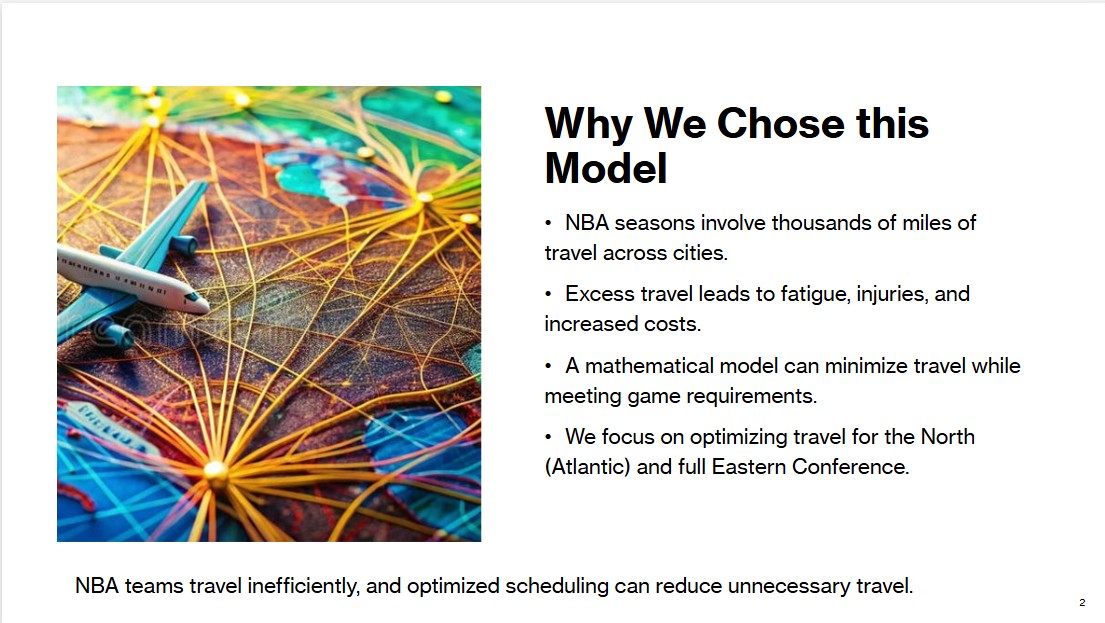
Here is our reason for choosing this model.

Next we gave a brief introduction to our project, talking about some of the constraints we found and the teams we are planning to focus on.

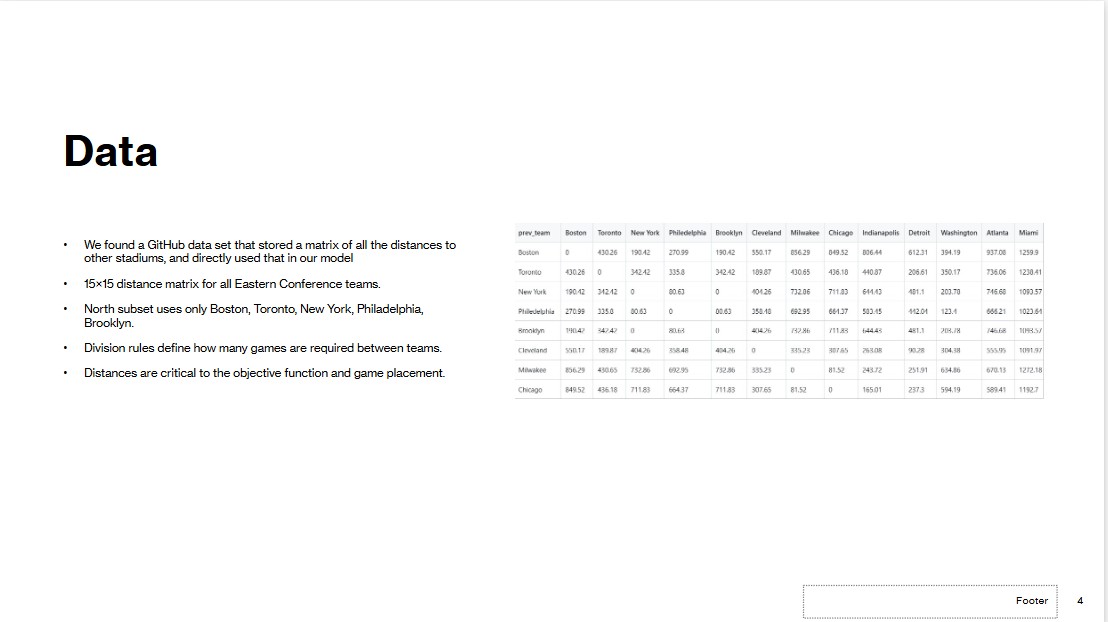
Here we showed a picture of our data set and explained where we found it from and how we formatted it. This part got a little tricky due to finding the data set online, and we were forced to format it into a smaller matrix that better fit our model we were working with

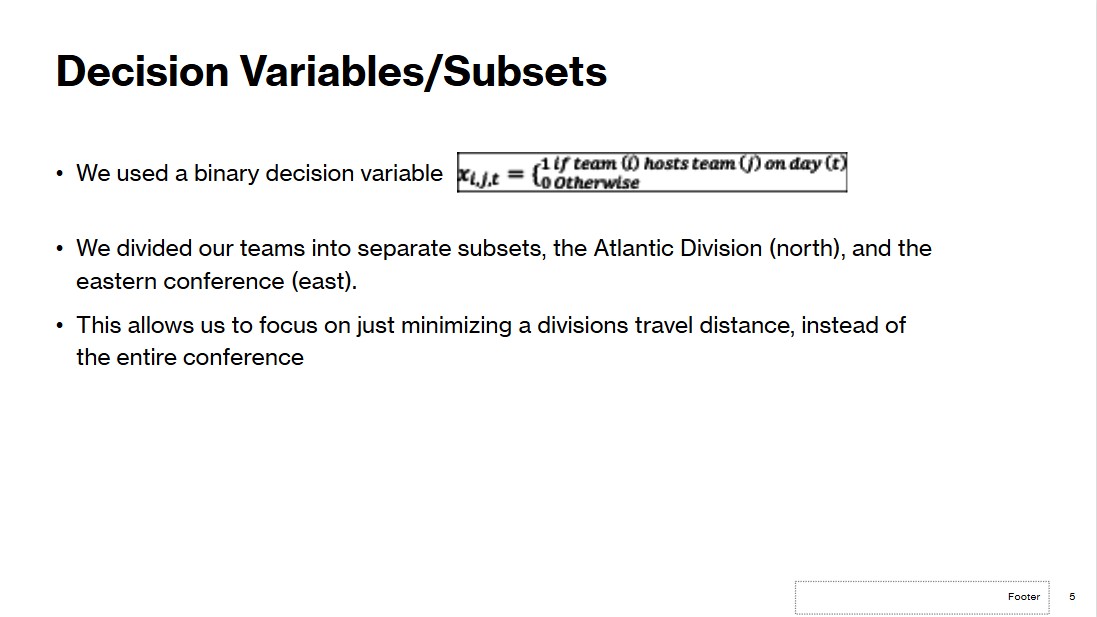
Now we begin describing our model and how we constructed it. We started with discusing our decision variable which is shown below, and then discussed the subsets for the different models we can run which allows our model to optimize two different sizes and constraints of data.

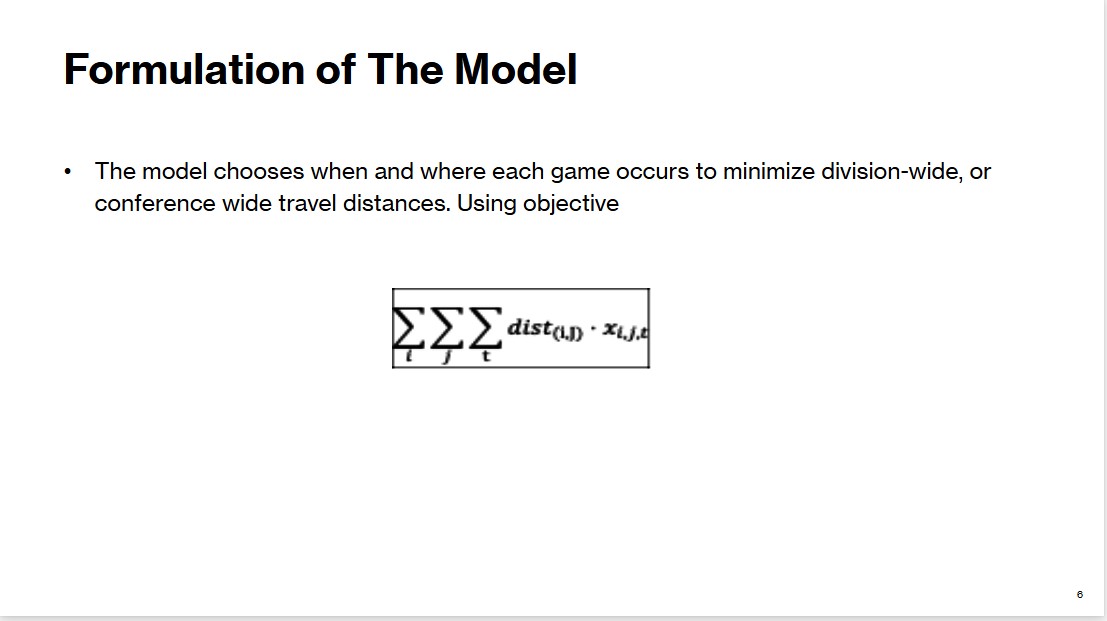
Here we gave our objective function and explained what it does for our model, which is minimize the travel distance of the Atlantic division for both of our models that we built.

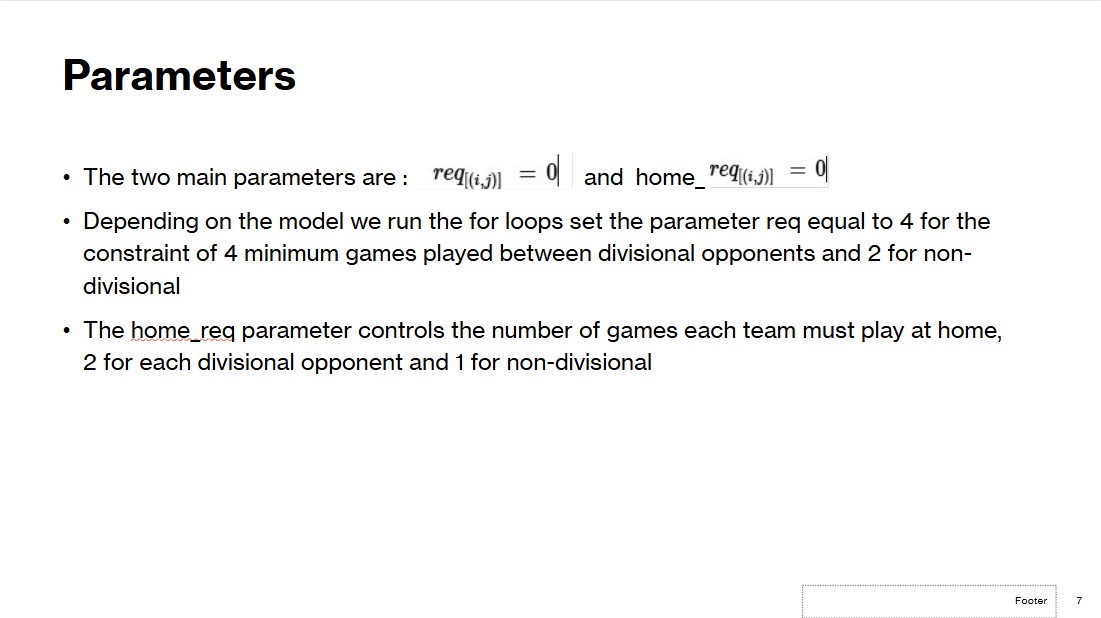
The parameters were created for the problem in order to ensure that each team plays a set amount of home and away games, multiple different teams, and both divisional and non divisional opponents

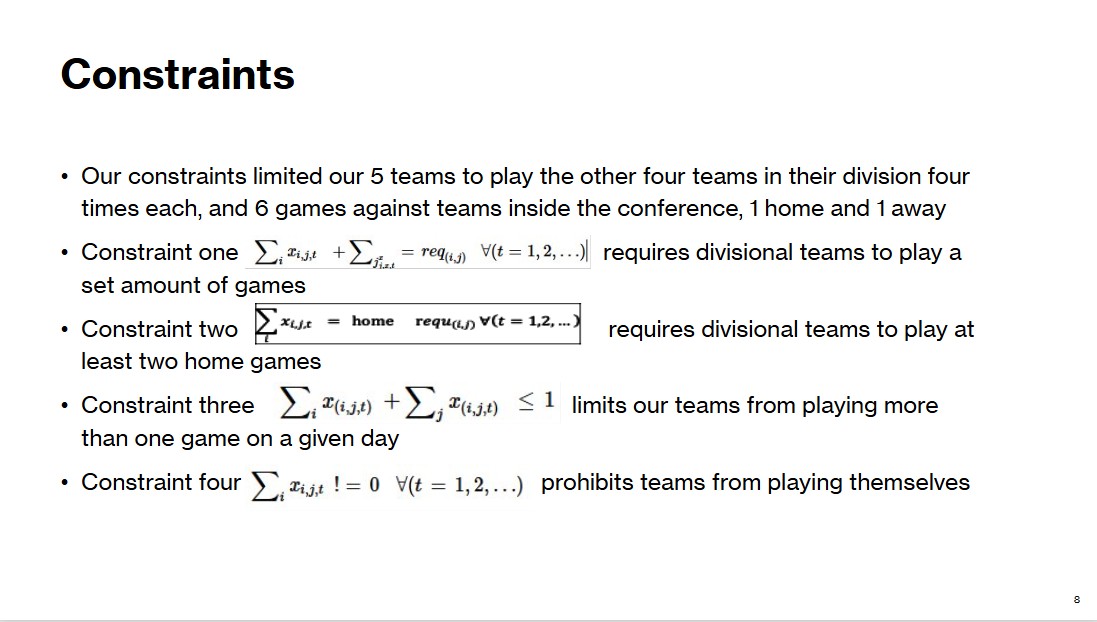
Finally, our constraints these go hand in hand with the parameters, and also help to ensure that no teams play themselves, or more than one game a day for either of our 60 day or 20 day models.

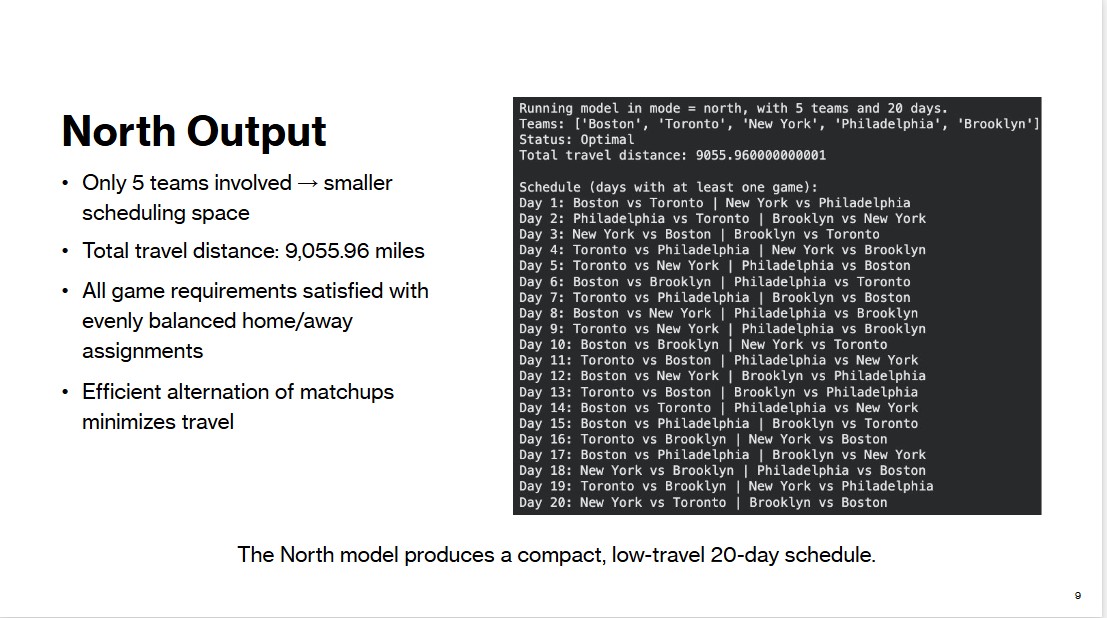
Here we discuss the output for the first model. This model focuses on just the division and only creates a schedule for 20 games, as you can see the output is very clean and gives a minimized travel distance of 9055.96 miles

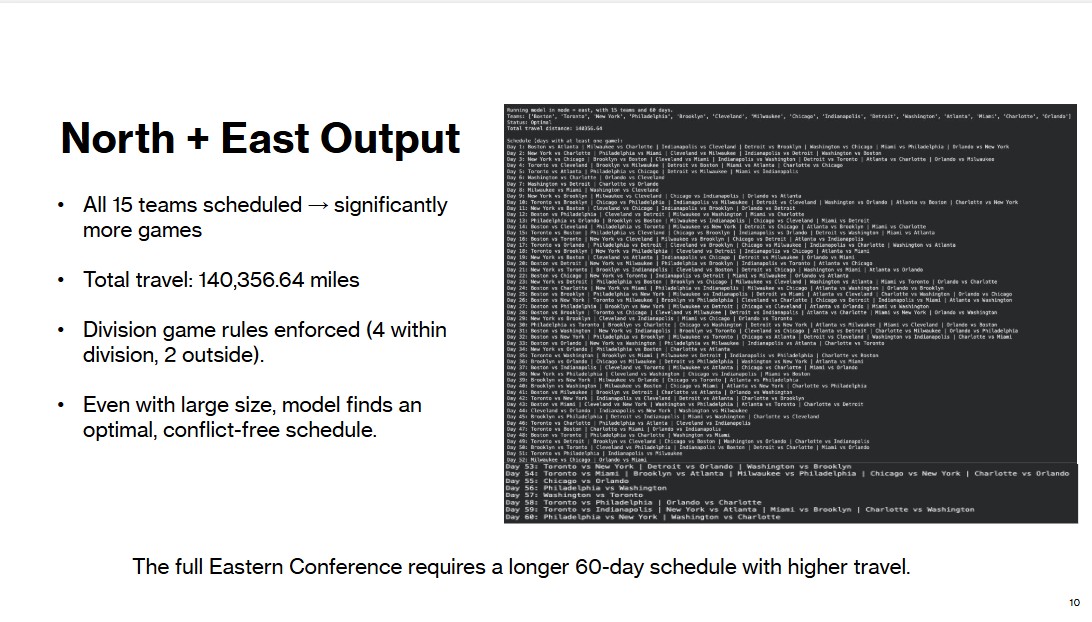
Next we discuss the output for the larger model, this output may not look as clean, but the model does a great job of ensuring our constraints happen, and focusing on just minimizing the travel for the Atlantic Division. Our result from this model was a minimal distance of 140,356.64 miles.

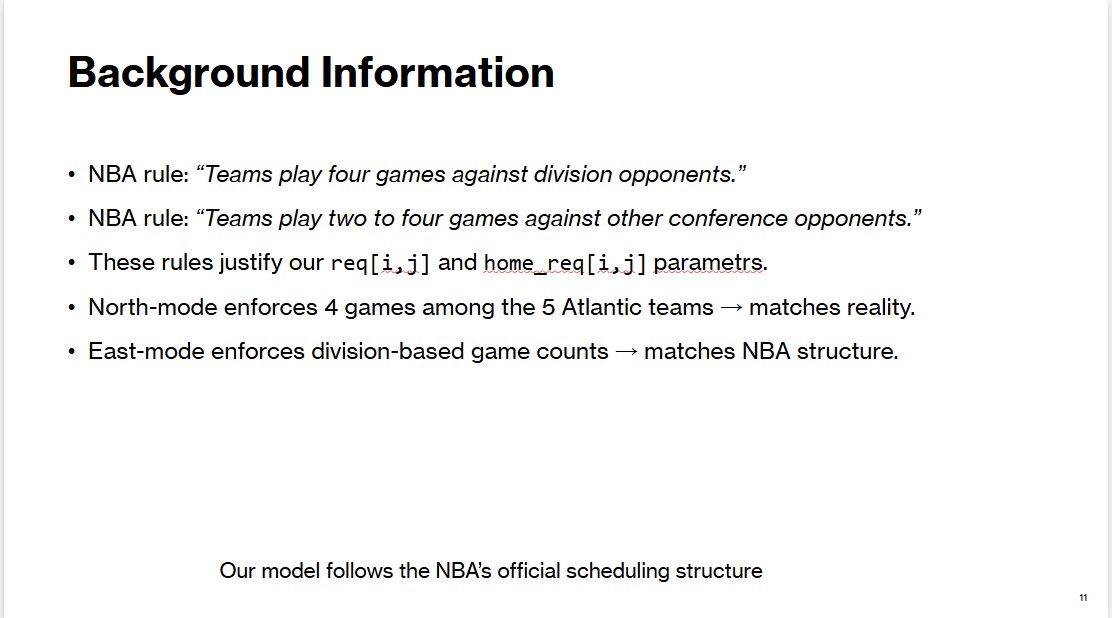
This slide is just meant to review and cover all of our background information, and the user understands each constraint

Finally, we end our PowerPoint with some of our Key Takeaways from the project, Thank you for your time and interest!